
Same Board, Different Views: Leading Edge's 2026 Board Report Finds Members, Chairs, and CEOs Experience Boards Differently
Leading Edge's 2026 board report hears from 1,180 individual board members at 62 Jewish nonprofits; most board/governance research surveys chairs and CEOs, leaving out individual board members.
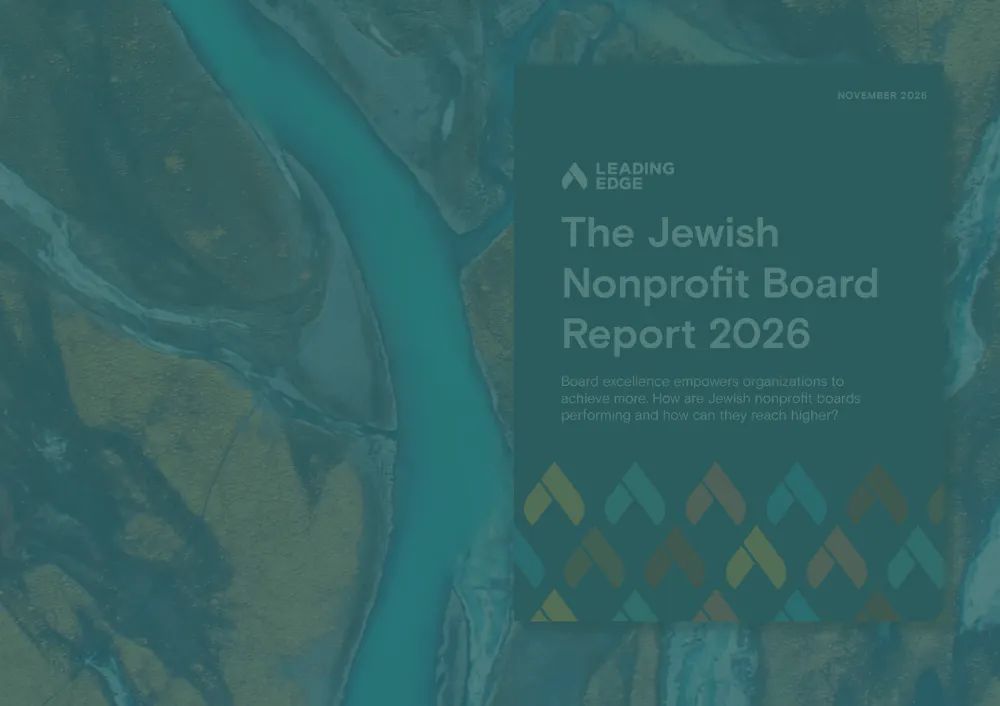
Most of what the nonprofit sector knows about how boards work comes from just two people per organization: the board chair and the CEO. A report released today by Leading Edge adds the people who make up most of every board. The Jewish Nonprofit Board Report 2026 shares findings from a survey of 1,180 individual board members at 62 Jewish nonprofits, alongside 63 chairs and 59 CEOs. That makes it the largest survey of board members ever conducted in the Jewish nonprofit field and, to Leading Edge's knowledge, the second-largest nonprofit board survey ever published in the United States, in any field.
The gap it fills is sector-wide. BoardSource's Leading with Intent, the benchmark study of U.S. nonprofit governance, surveys only chairs and CEOs. The same is true of Leading Edge’s previous board research.
The report draws on Leading Edge’s 2026 Board Experience Survey, fielded in February 2026 with the boards of the 62 organizations in the first cohort of Leading Edge's Board Leadership Accelerator. While individual board members rarely get surveyed, they answered when asked: 87% of the roughly 1,500 people invited responded, well above the two-thirds response rate typical of surveys in organizational research. The research was made possible by The Marcus Foundation (established by the late Bernie Marcus, co-founder of The Home Depot, with his wife Billi).
The view from every seat. Hearing from all three roles shows how differently the same board can look depending on where you sit. Chairs were the likeliest to answer favorably (agree or strongly agree) on nearly every question about how their board functions, CEOs the least likely, and members fell in between. On more than a third of questions, chairs and CEOs were 16 points or more apart. The widest gaps show up where boards most need to be aligned:
- Only 20% of CEOs say their board implements regular feedback, compared with 40% of chairs.
- 38% of CEOs say the board fulfills its fundraising obligations, compared with 61% of chairs.
- 34% of CEOs say board leadership cultivates a pipeline of qualified candidates, compared with 56% of chairs.
Members' answers add what a chair-and-CEO survey cannot: for example, 95% of chairs say their board service lets them use their skills and expertise, against 75% of members, and that question about using people’s skills has the strongest link of any in the survey to how board service feels overall. Nearly every chair (95%) would recommend their board as a great place to serve; 81% of members and 75% of CEOs would.
“Board talent matters,” said Gali Cooks, President & CEO of Leading Edge. "Excellence doesn’t stop at the staff door; it has to reach the boardroom. This report is a mirror of where boards are today and a map of where they can go. ”
Other key findings:
- Culture is the biggest growth area. Of the six areas the survey measured, Board Culture had the lowest average favorability (68%). 85% of respondents report trusting relationships with fellow members, yet the two lowest-rated questions in the entire survey concern how the board works as a group: whether it implements regular feedback (49%) and whether it enables organizational experimentation (53%).
- CEO succession planning lags the sector. Just 8% of the organizations surveyed have a CEO succession plan, and 11% have an emergency succession plan. In BoardSource's national data, 35% of nonprofits report a written succession plan and 33% a written emergency plan.
- Screen time can strain boards. Members of mostly virtual boards reported lower average favorability than members of boards using in-person and hybrid formats.
- Social time outside formal board meetings helps — to a point. Members of boards that spend five to nine hours a year together outside formal business reported the highest favorability on 28 of 35 questions; past nine hours, the advantage largely disappears.
- Some of the strongest practices are within easy reach. Having a written onboarding guide for board members and creating fundraising strategies as a board-professional partnership (rather than leaving it to staff alone) are both associated with a more positive board experience.



Loading footer...